Will lip filler make me look overdone?
Lip filler does not have to look overdone. Dosed to your anatomy and built gradually, it reads as rested and balanced, still recognizably you. Here is how a natural result is actually decided.
Reviewed by our licensed injector team, July 2026 · 6 minute read
Will lip filler make me look overdone?
Not if it is dosed to your anatomy and built gradually. The overdone look comes from too much product placed too fast, not from filler itself. A conservative first treatment, planned around your natural lip shape, reads as rested and balanced, never inflated. You stay recognizably you.
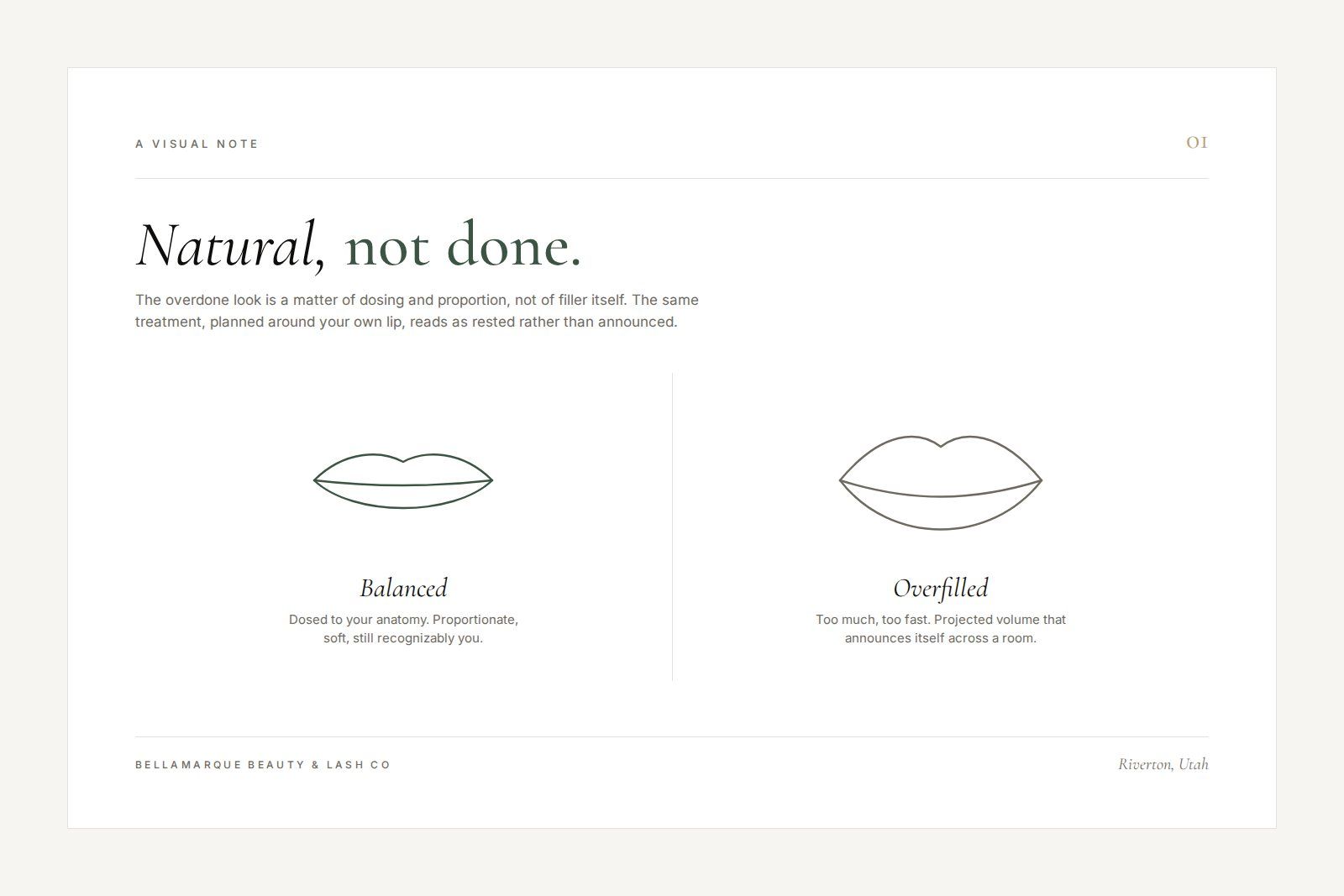
The overdone look almost never comes from filler as a material. It comes from decisions: too much product, placed too quickly, without respect for the lip you started with. When the upper lip is overfilled relative to the lower, or when volume is pushed forward instead of supporting the natural border, lips can look projected or duck-like. That is a technique and dosing problem, not an inevitability.
Done conservatively, filler adds a small amount of structure and hydration to what is already there. The goal is a lip that looks like it did on a good day: slightly more defined, softly fuller, still yours. Most people around you should not be able to name what changed. They should only notice you look rested. If a result would announce itself across a room, it was overdone, and that is avoidable.
How is a natural amount of lip filler actually decided?
By anatomy, not by a fixed number. A thoughtful injector reads your lip proportions, your resting shape, the balance between upper and lower, and your surrounding features first. The plan follows what your face already supports. Often that means using less than you expected and building over more than one visit.
There is no universal correct amount of lip filler, because there is no universal lip. Your injector should be looking at the ratio between your upper and lower lip, how much pink shows when you rest and when you smile, the shape of your cupid's bow, and how your lips relate to your nose and chin. A number that flatters one face will overwhelm another.
This is why we under-treat on purpose, especially at a first visit. It is far easier to add a little more at a follow-up than to dissolve something that went too far. Building gradually lets you live with a subtle change, see how it settles, and decide calmly whether you want anything else. Restraint is not the cautious option. It is usually the better-looking one.
What is the appointment and the conversation actually like?
Calm and unhurried. Expect a real consultation before any needle: your goals, your concerns about looking overdone, and an honest read on what you actually need. If your lips do not need filler yet, you should be told that plainly. No pressure, no upsell, no quota.
A good lip appointment starts with talking, not injecting. You should be asked what bothers you, what you are hoping for, and specifically what you are afraid of, because most thoughtful patients are quietly afraid of looking overdone. That fear is useful information. It tells your injector to stay conservative and to check in as they go.
You should also be told the truth about what you do not need. Sometimes the honest answer is that your lips are balanced already, or that a smaller amount than you imagined will get you where you want to be, or that hydration and a little definition matter more than volume. Being told no, or not yet, is a sign you are in the right chair. No quota, no pressure, and no treating you like a transaction.
How much filler do you need for a natural look?
For a natural first result, most people need less than a full syringe, or a single conservative syringe placed carefully. The exact amount depends on your anatomy, not a trend. Under-treating on purpose and reviewing at two weeks is safer than chasing fullness in one sitting.
Trends have made big numbers sound normal. In practice, a natural first-time result is often achieved with a conservative amount, sometimes less than a full syringe, placed with intention rather than emptied in for its own sake. The measure of a good outcome is not how much was used. It is how balanced and unforced the lip looks afterward.
If more definition is wanted later, it can be layered in at a future visit once the first result has fully settled. This staged approach protects the natural look and gives you control over the pace. You are never obligated to use a whole syringe simply because it was opened, and a trustworthy provider will treat your comfort, not the vial, as the limit.
How long does lip filler last?
Approximately six to twelve months for most hyaluronic-acid lip fillers, though this varies with the product used, your metabolism, and how much was placed. Lips are mobile and tend to metabolize filler faster than some other areas. Treat longevity as a range, not a promise, and plan for gradual maintenance.
Most hyaluronic-acid lip fillers last somewhere in the range of six to twelve months, but that window is genuinely individual. Lips move constantly when you talk, eat, and smile, and that motion tends to break filler down faster than in less mobile areas. Your metabolism, the specific product chosen, and how much was placed all shift the timeline.
Think of longevity as a range to plan around, not a guarantee to bank on. Many people choose to refresh gradually as the effect softens, which keeps the look consistent and subtle over time rather than swinging between full and flat. There is no obligation to maintain it. If you let it fade, your lips simply return toward their baseline.
Does it hurt, and what is recovery and swelling like?
Most people describe it as very tolerable. Numbing cream and lidocaine within the filler keep discomfort low. Expect some swelling for a few days, possible bruising, and tenderness. Lips can look bigger and uneven at first, then settle over about two weeks as swelling resolves.
Comfort has come a long way. A topical numbing cream is usually applied first, and most modern lip fillers contain lidocaine, so the area becomes progressively less sensitive as treatment goes on. Most people describe pressure and small pinches rather than sharp pain. It is a short appointment, and you stay in control, free to pause at any point.
Afterward, honesty matters more than reassurance. Expect swelling for a few days, and know that lips can look larger, firmer, and slightly uneven at first. Bruising is possible, especially at injection points, and is not a sign anything went wrong. The two-week mark is the honest checkpoint: by then swelling has resolved and you are seeing your true, settled result. Judging your lips on day one is judging swelling, not filler.
Can lip filler be dissolved or reversed if I change my mind?
Yes, in most cases. Modern lip fillers are hyaluronic-acid based, which means they can be dissolved with an enzyme called hyaluronidase if you dislike the result or want to start over. This reversibility is one reason HA filler is a reassuring first step for cautious, first-time patients.
One of the most reassuring facts for a careful patient is that most lip filler today is not permanent and is reversible. Hyaluronic-acid fillers can be broken down with hyaluronidase, an enzyme that dissolves the product, if you decide you want less, want it gone, or simply changed your mind. Several HA filler brands exist, and a good injector will explain which they use and why.
This does not mean dissolving is a casual step or a routine plan. It is a safety net, not the goal. But knowing the door is not locked behind you takes a great deal of pressure off the decision. You are not committing to a face for life. You are trying something adjustable, with a way back if it is not for you.
How do I choose a provider so my results look natural?
Look for a licensed, experienced injector who shows before-and-afters on patients your age and your starting anatomy, not just dramatic transformations. Ask about their dosing philosophy. A provider who talks about restraint, settling time, and reversibility, and who is willing to tell you no, is the one to trust.
The single biggest factor in whether lip filler looks natural is the person holding the syringe. Credentials and licensing matter, but so do aesthetic judgment and restraint. Ask to see before-and-after photos of patients who started with lips like yours and who are close to your age, not only dramatic makeovers on much younger faces. Same-age, same-starting-point proof tells you far more about your likely result.
Look for a provider whose philosophy centers on natural results, gradual dosing, and honesty, including the willingness to tell you that you do not need a treatment. That is the standard we hold for lip filler in Riverton, Utah: conservative by default, no pressure, and always aimed at looking like a rested version of yourself rather than a different person. If a consultation feels like a sales pitch, keep looking.
Book your visit when it suits you.
Book a calm, no-pressure visit and a licensed provider will talk it through with you.
No pressure, ever. Cancel or reschedule anytime.